
Butterball Bites off More than he Can Chew
By Jackson Forman
“We have a fish problem,” Mrs. Sauer said frantically.
It was the afternoon of December 5. I was working on a Social Studies project in WIN when the science teacher ran in to ask for my help. I am known as “the fish guy” because I am an avid fisherman as well as a maker of fishing hooks.
The problem was with one of the tilapias in our aquaponics tank. He is bigger than the rest, and a lot more mean. He is everyone’s favorite. His name is Butterball. He had been pushing all of the other fish into a corner and attacking them. And on December 5, he tried to eat one of his tankmates.
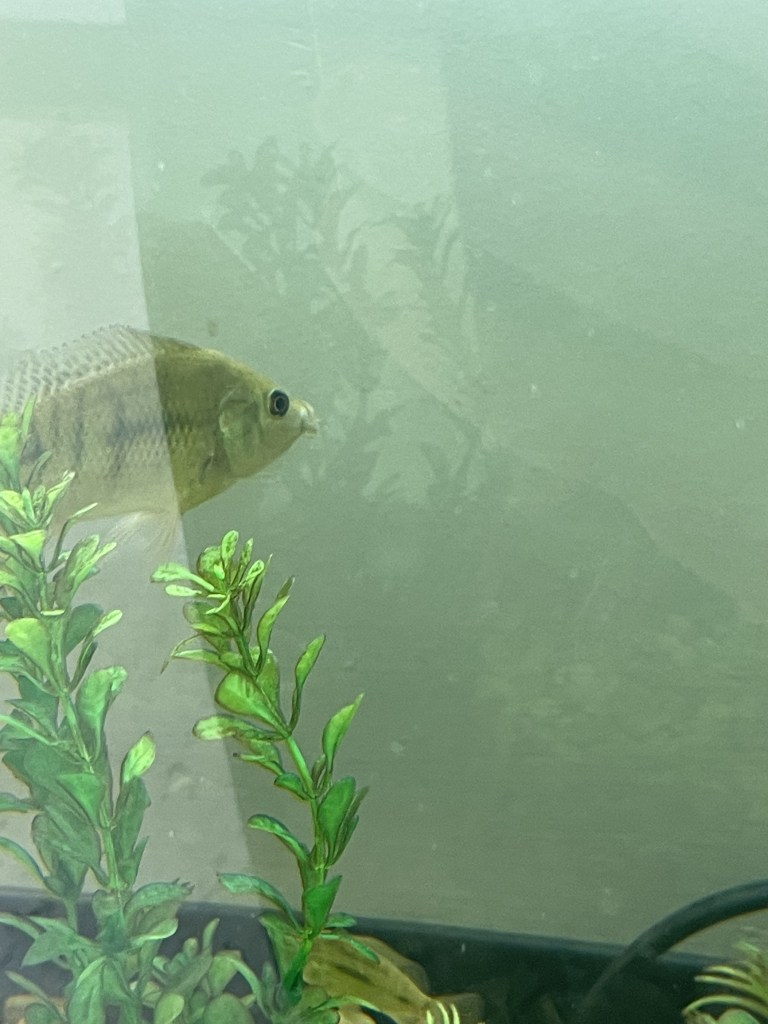
Mrs. Sauer and I walked over to the tank, down in the primary hallway, and I saw Butterball with a fishtail hanging out of his mouth, struggling to breathe. I assumed Butterball was trying to eat another fish, either because he needed more to eat, or just because male tilapia can be very hostile.
I filled up a bin with tank water. Because the sink water is much colder than the tank water, if I were to get water from a sink or a water fountain, he would have gone into shock or could have even died. I had to use tank water because he was already acclimated to it. Now I had to net Butterball. Because it is such a big tank (90 gallons), and he is so small, it took a few minutes to get him in the net. Once I got him in the net, I put him in the bin. I could see that he was moving slower than usual. Now it was time to get the fish out of there.


Photos courtesy of Mrs. Sauer.
First, I tried just seeing if I could pull the fish out with my fingers, but I couldn’t. This is because of the dorsal fin. The dorsal fin on a tilapia is lined with spines angled towards the tail of the fish. If I pulled too hard, the spines would get stuck deeper in the mouth of Butterball.
I used tweezers to knock down the dorsal spines and then another pair of tweezers to pull the tail. I got the fish out, but there was a little piece stuck in the throat. Butterball was still moving slowly, but he was alive. To revive him, I needed more water in the bin. I put him in the bin and got more water for it. I grabbed him by the tail and swam him back and forth. He started doing way better. This works by allowing water to go through the gills if the fish can’t do it himself. I felt confident enough that he could go back into the tank. I put him back and he was doing well, though still breathing differently because he had some of the partially digested fish still stuck in his throat.
Later that day I went to check on him, and he was back to his normal self.
Early this month, we received three new fish from a Forrestdale School in Rumson because their tank was overfull. The fish are four or five months old, and larger than Butterball, which is changing the dynamic of the tank. We also installed an automatic feeder, which feeds the fish twice a day instead of once, Mrs. Sauer said.
“Let’s hope Butterball learned his lesson, and fingers crossed we don’t see cannibalism in our tank in the near future,” Mrs. Sauer said, adding, “Butterball might have died a cannibal if it wasn’t for our fish expert who became a doctor on the spot!”
 The Tides
Great job, Jackson!
LikeLiked by 1 person
Dr. Forman please report to the aquaponic operating room – STAT!! Very interesting article Jackson, great description of the tilapia dorsal fin issue and how you solved the problem. BRAVO to our resident ” fish guy”!!!
LikeLike
What a great retelling of the story. And great job putting your vast knowledge to work!
LikeLike